


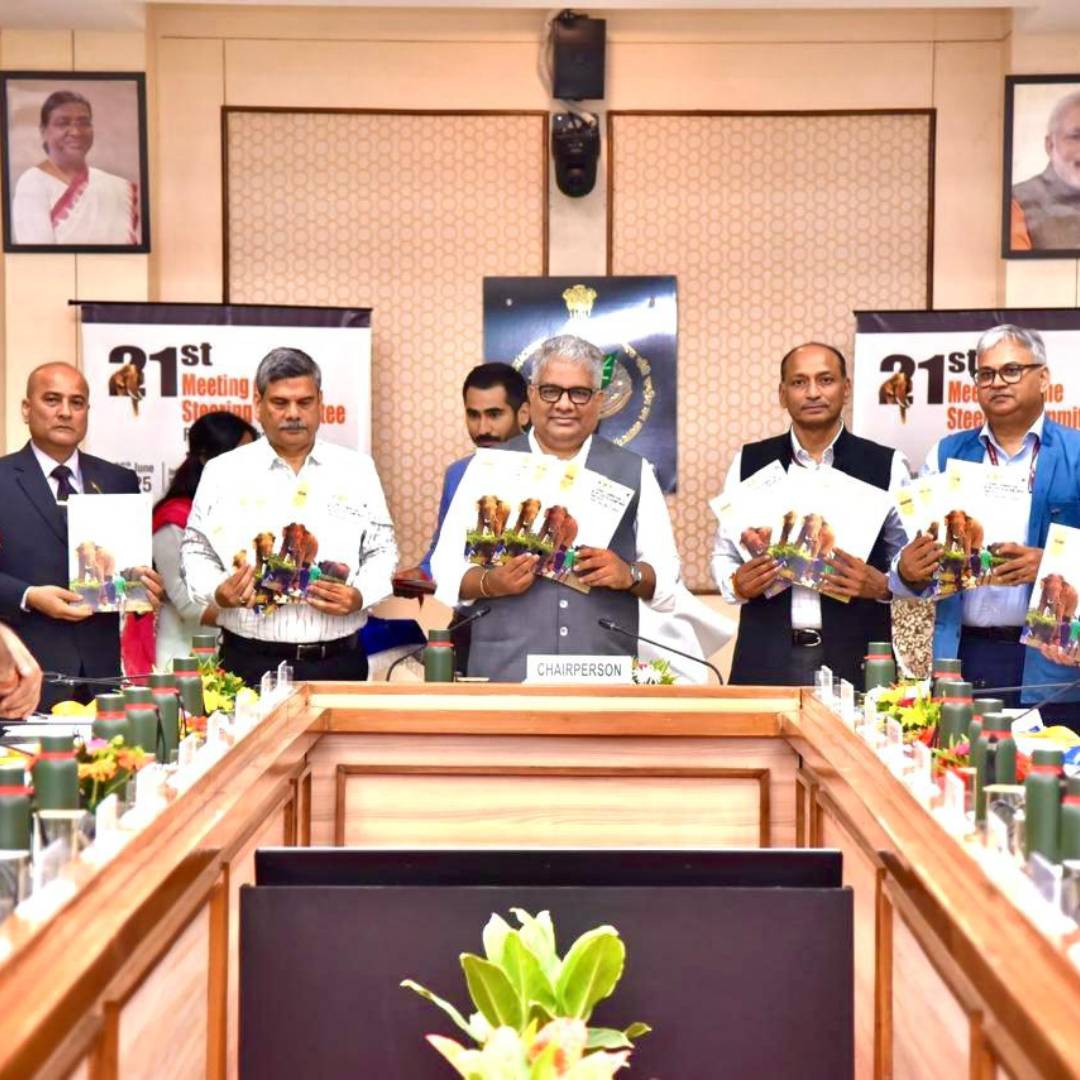
The 21st Steering Committee Meeting of Project Elephant was held on June 26, 2025, at the Indira Gandhi National Forest Academy (IGNFA), Dehradun, under the chairmanship of Union Environment Minister Shri Bhupender Yadav. The meeting brought together senior officials, scientists, and conservation experts from across India’s elephant range states to review the project’s progress and plan future strategies for protecting the country’s endangered elephants.
Addressing Human-Elephant Conflict: A Core Challenge
One of the key concerns highlighted during the meeting was the ongoing human-elephant conflict, which poses serious risks to both people and elephants. Union Minister Bhupender Yadav stressed the need to actively involve local communities in conservation efforts, calling them essential partners rather than mere stakeholders. He also advocated for stronger conflict mitigation strategies, improved working conditions for frontline forest staff, and measures to safeguard their social security and well-being.
Multi-Sectoral Coordination for Conservation
A key concern highlighted during the meeting was the ongoing human-elephant conflict, which poses serious risks to both people and elephants. Union Minister Bhupender Yadav stressed that involving local communities is essential for effective wildlife conservation. “Local communities are not merely stakeholders—they are vital partners,” he noted. He also called for stronger conflict mitigation strategies, improved support for frontline forest staff, and greater attention to their safety and welfare.
Key Conservation Initiatives Reviewed
The Committee reviewed several major initiatives under Project Elephant:
- DNA Profiling of Captive Elephants: 1,911 elephants across 22 states have been genetically profiled, strengthening documentation and monitoring.
- Elephant-Train Collision Mitigation: Surveys across 3,452.4 km of railway tracks pinpointed 77 high-risk zones, with specific mitigation measures recommended.
- Human-Elephant Conflict Regional Action Plans: Draft plans are being developed for Southern and North-Eastern India, to address region-specific issues.
- North-East Elephant Census: The first phase of synchronized elephant population estimation in the North-East was completed with over 16,500 dung samples collected for analysis.
- Nilgiri Elephant Reserve Plan: A Model Elephant Conservation Plan (ECP) for the Nilgiris is currently under development and is expected to be finalized by December 2025.
Notable Reports and Publications Released
The meeting saw the launch of several critical documents:
- A detailed report on elephant-train collisions, suggesting practical mitigation strategies.
- A 23-year conflict study covering Assam, Jharkhand, and Chhattisgarh, offering in-depth insights into patterns and root causes.
- An advisory on safe tusk trimming for captive elephants, addressing welfare and safety protocols.
- The latest edition of Trumpet, Project Elephant’s quarterly newsletter.
Preparing for World Elephant Day 2025
Preparations are underway for World Elephant Day on August 12, 2025, to be celebrated in Coimbatore, Tamil Nadu. The prestigious Gaj Gaurav Awards, recognizing outstanding contributions to elephant conservation, will be presented at the event.
Roadmap Ahead: Community and Knowledge at the Core
Looking forward, several important steps were identified:
- Finalization of the Nilgiri ECP and initiation of a three-year elephant tracking study in Bandhavgarh Tiger Reserve.
- Launch of Management Effectiveness Evaluations (MEE) in Elephant Reserves with CAMPA support.
- Development of an integrated conservation strategy for Ripu-Chirang Elephant Reserve, particularly focusing on the Udalguri landscape.
A Renewed Commitment to Inclusive Conservation
The Committee reaffirmed its dedication to a conservation approach that is community-based, driven by traditional knowledge, and underpinned by scientific data. With continued collaboration between governments, institutions, and communities, Project Elephant aims to not only protect India’s elephant population but also ensure harmonious coexistence between humans and wildlife.