


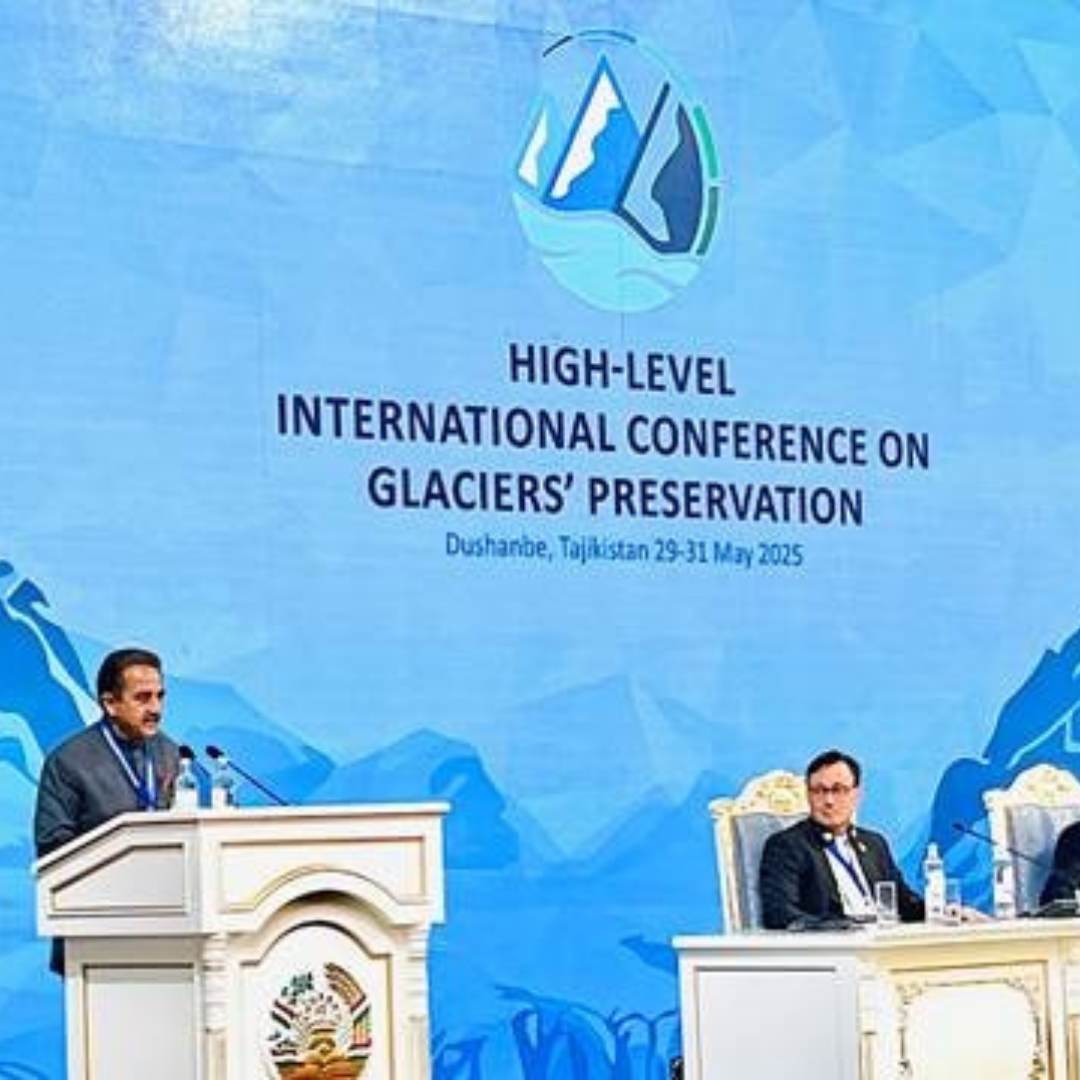
Shri Singh, the Union Minister of State for Environment, Forest and Climate Change (EFCC) of India, delivered a powerful address at the Plenary Session of the High-Level International Conference on Glaciers’ Preservation, held from 29th to 31st May 2025 in Dushanbe, Republic of Tajikistan. This landmark global event brought together international experts, policymakers, scientists, and ministers to discuss urgent measures to protect the world’s glaciers—vital freshwater sources and key indicators of the planet’s changing climate.
In his keynote address, Shri Singh emphasized that the accelerated retreat of glaciers is not merely a warning but a present and pressing reality with profound consequences for global water security, biodiversity, and the livelihoods of billions, particularly in vulnerable regions. He noted that glaciers are the lifeblood of ecosystems and human societies, and their decline could destabilize not only regional hydrology but also international peace and development frameworks.
India’s Himalayan Imperative
Highlighting the disproportionate impact of glacial retreat on mountainous regions such as the Himalayas, Shri Singh reiterated India’s deep-rooted concern as a country intrinsically tied to the Himalayan ecosystem. “For India, the health of the Himalayan glaciers is not just an environmental issue—it is a matter of national survival and security,” he stated.
The Minister explained that India has been a leader in combining scientific research with policy action to tackle the challenges of glacial retreat. He highlighted key initiatives under the National Mission for Sustaining the Himalayan Ecosystem (NMSHE), a vital part of India’s National Action Plan on Climate Change (NAPCC), which aims to understand and conserve the fragile Himalayan environment through targeted research, community involvement, and policy-driven solutions in response to global climate change.
In a significant development, Shri Singh announced the establishment of a Centre for Cryosphere and Climate Change Studies, aimed at strengthening research and monitoring of glaciers and glacial lakes across the Indian Himalayan Region. This Centre will serve as a national hub for integrating cryospheric science with climate adaptation strategies.
Technological Innovation and Scientific Leadership
The Minister emphasized India’s cutting-edge use of Remote Sensing and Geographic Information System (GIS) technologies, led by the Indian Space Research Organisation (ISRO), to monitor changes in glacier mass, area, and movement patterns. These initiatives play a vital role in providing real-time data to support informed policy-making and enhance disaster preparedness.
He acknowledged the pivotal role of premier Indian research institutions such as the National Centre for Polar and Ocean Research (NCPOR), National Institute of Hydrology (NIH), Wadia Institute of Himalayan Geology, and the G.B. Pant National Institute of Himalayan Environment (NIHE). Their coordinated research is enhancing scientific understanding of glacial systems and informing the sustainable management of India’s freshwater resources.
Furthermore, Shri Singh emphasized India’s proactive steps in improving early warning systems and Glacial Lake Outburst Flood (GLOF) risk mapping, under the aegis of the National Disaster Management Authority (NDMA). These interventions aim to reduce vulnerabilities in high-risk Himalayan communities.
Climate Justice and Global Cooperation
In the global context, the Minister reaffirmed India’s unwavering commitment to climate equity and the principle of Common but Differentiated Responsibilities and Respective Capabilities (CBDR–RC). He pointed out that South Asia contributes minimally to global greenhouse gas emissions but remains one of the most climate-vulnerable regions, underscoring the moral imperative for international support.
Shri Singh highlighted India’s achievements under the Paris Agreement, including:
- Sourcing over 48% of installed electricity capacity from non-fossil fuel-based energy;
- Achieving a 36% reduction in the emission intensity of GDP between 2005 and 2020;
- “Added a carbon sink of 2.29 billion tonnes CO₂ equivalent through increased forest and tree cover between 2005 and 2021.”
“These accomplishments reflect India’s resolve to lead by example,” the Minister declared, “while also advocating for differentiated, context-specific climate actions that account for national circumstances and developmental priorities.”
A Call for United Global Action
In conclusion, Shri Singh welcomed the designation of 2025 as the International Year of Glaciers’ Preservation and the launch of the Decade of Action for Cryospheric Sciences (2025–2034). He emphasized the pressing need for stronger global collaboration, greater scientific exchange, and enhanced financial and technological support for developing countries to ensure the long-term conservation of glaciers and the well-being of the communities that rely on them.
“India stands ready to partner with the global community,” Shri Singh affirmed, “to share expertise, catalyze innovation, and contribute meaningfully to collective efforts in preserving the planet’s glaciers and securing our shared future.”
The conference concluded with renewed global resolve to act decisively, underscoring the crucial role of political will, scientific collaboration, and international solidarity in confronting the growing crisis of glacial retreat.