


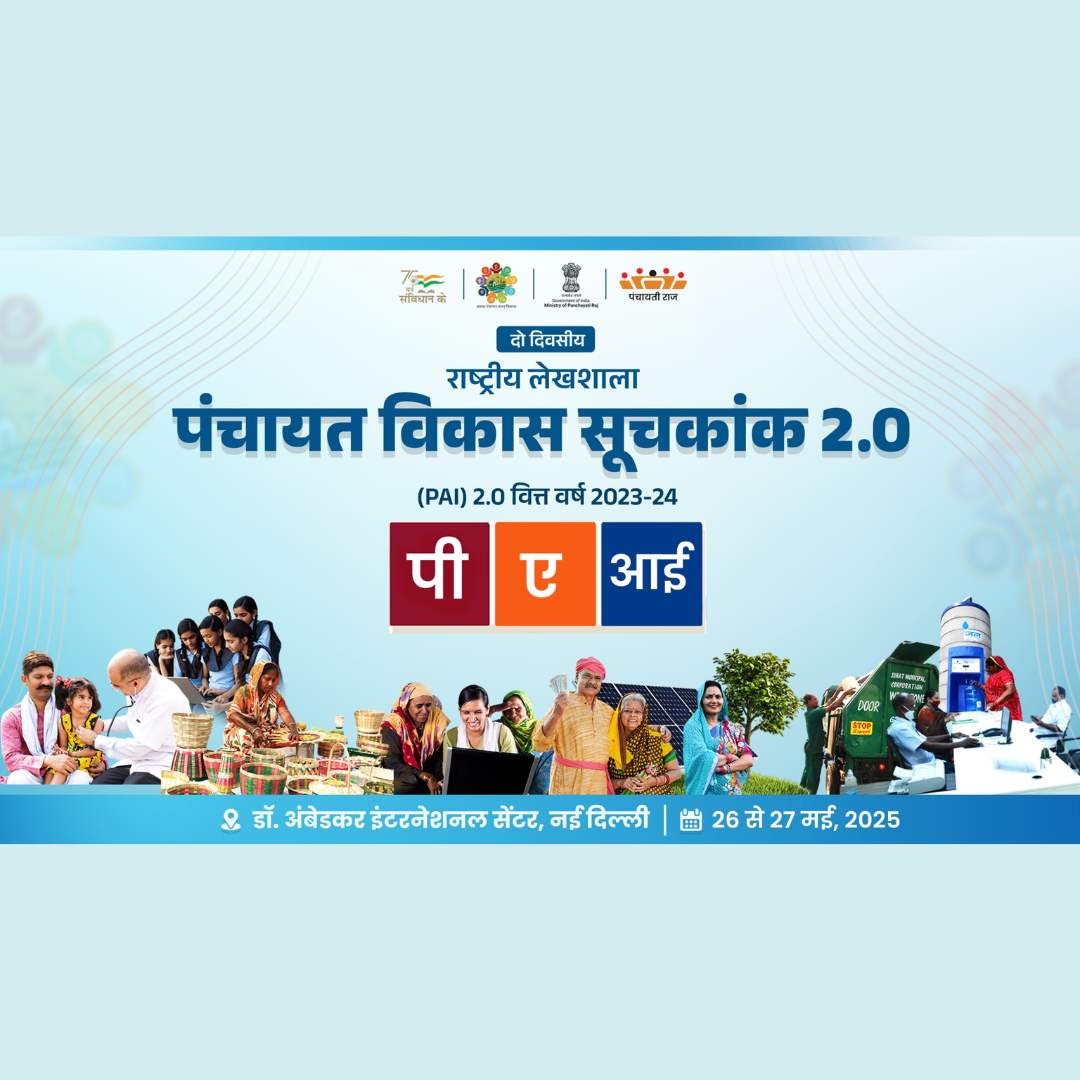
The Ministry of Panchayati Raj (MoPR) is hosting a two-day National Writeshop on the Panchayat Advancement Index (PAI) Version 2.0 on 26th–27th May 2025 at Dr. Ambedkar International Centre, New Delhi, marking a pivotal step in advancing decentralized, data-driven governance in rural India.
The event celebrates the national rollout of PAI 2.0 for the financial year 2023–24 and is strategically designed to build capacities among key stakeholders for data-based monitoring, evaluation, and planning at the Gram Panchayat level. It reflects the Ministry’s commitment to empowering Panchayati Raj Institutions (PRIs) to deliver holistic, inclusive, and sustainable development in rural India.
Inaugural Session and Distinguished Presence
The Writeshop opened with an inaugural session graced by distinguished dignitaries:
- Shri Vivek Bharadwaj, Secretary, Ministry of Panchayati Raj
- Shri Saurabh Garg, Secretary, Ministry of Statistics and Programme Implementation
- Shri Sushil Kumar Lohani, Additional Secretary, MoPR
- Shri Rajib Kumar Sen, Senior Advisor, NITI Aayog
Senior officers from various ministries, development experts, and technical specialists also participated, highlighting the multi-sectoral importance of the Panchayat Advancement Index as a transformative governance tool.
Evolution from PAI 1.0 to PAI 2.0
The Panchayat Advancement Index has emerged as a comprehensive and dynamic framework for assessing and tracking the developmental progress of over 2.6 lakh Gram Panchayats across India. Aligned with the Localized Sustainable Development Goals (LSDGs), it measures performance across nine key thematic areas, including:
- Poverty Alleviation
- Health and Nutrition
- Education and Learning
- Water Sufficiency
- Clean and Green Environment
- Infrastructure Development
- Good Governance
- Social Justice and Inclusion
- Women’s Empowerment
While PAI 1.0 served as a baseline assessment for FY 2022–23, PAI 2.0 integrates valuable field-level learnings and stakeholder feedback to enhance usability, reduce complexity, and ensure better actionable outcomes.
Key Enhancements in PAI 2.0
PAI 2.0 introduces several groundbreaking improvements that make it more accessible, user-friendly, and action-oriented:
- Reduction of Indicators: Streamlining from 516 to 147 indicators, improving focus and reducing data entry burden.
- Refined Local Indicator Framework (LIF): Focuses on measurable, results-oriented indicators across all nine LSDG themes.
- Automated Data Integration: Seamless syncing with national portals of various Union Ministries for real-time updates.
- Enhanced Portal Design: A mobile-friendly interface, intuitive dashboards, and user-centric navigation for ease of use at the grassroots level.
- Validation Mechanisms: In-built data quality controls and anomaly detection to ensure accuracy and reliability.
- Decision Support System: Helps local governments identify development gaps and make informed decisions for resource allocation and planning.
Writeshop Activities and Objectives
During the two-day Writeshop, the following major components are being undertaken:
- Unveiling of the Local Indicator Framework (LIF) Booklet for FY 2023–24
- Launch of the enhanced PAI 2.0 Portal along with updated Standard Operating Procedures (SOPs)
- Technical Sessions on:
- Insights from PAI 1.0 Baseline Report
- Methodology and framework behind PAI 2.0
- Demonstrations of portal functionalities
Participants are also engaging in hands-on exercises, including:
- Portal configuration and navigation
- Data entry and validation techniques
- Using PAI outputs in planning processes for Gram Panchayat Development Plans (GPDPs)
State Participation and Shared Learnings
On the second day, delegates from 32 States and Union Territories are set to share their on-ground experiences with PAI 1.0 and outline strategic plans for implementing PAI 2.0. These presentations aim to highlight:
- Success stories and implementation challenges
- Use of data in prioritizing developmental initiatives
- Customization of strategies to suit local needs
Participants include senior officials from various departments—Panchayati Raj, Health, Education, Rural Development, Public Health Engineering, Women and Child Development—as well as technical teams from NITI Aayog, MoSPI, NIC, and development partners such as UNICEF, UNFPA, Tribal Research Institute (TRI), and Piramal Foundation.
Multilingual National Outreach
In a move to promote linguistic inclusivity and transparency, the entire event is being livestreamed in eleven Indian languages:
- Assamese, Bengali, English, Gujarati, Kannada, Malayalam, Marathi, Odia, Punjabi, Tamil, Telugu
This ensures that grassroots stakeholders, regardless of language or region, can engage meaningfully with the PAI framework and its national rollout.
Conclusion
The National Writeshop on PAI 2.0 signifies a pivotal step toward data-driven rural governance. By equipping Gram Panchayats with real-time, measurable, and actionable data, the Ministry of Panchayati Raj is fostering a transparent, efficient, and citizen-centric development model in India’s villages. As rural India marches towards the achievement of the LSDGs, PAI 2.0 will serve as a compass, guiding Panchayats toward inclusive and equitable growth for all.